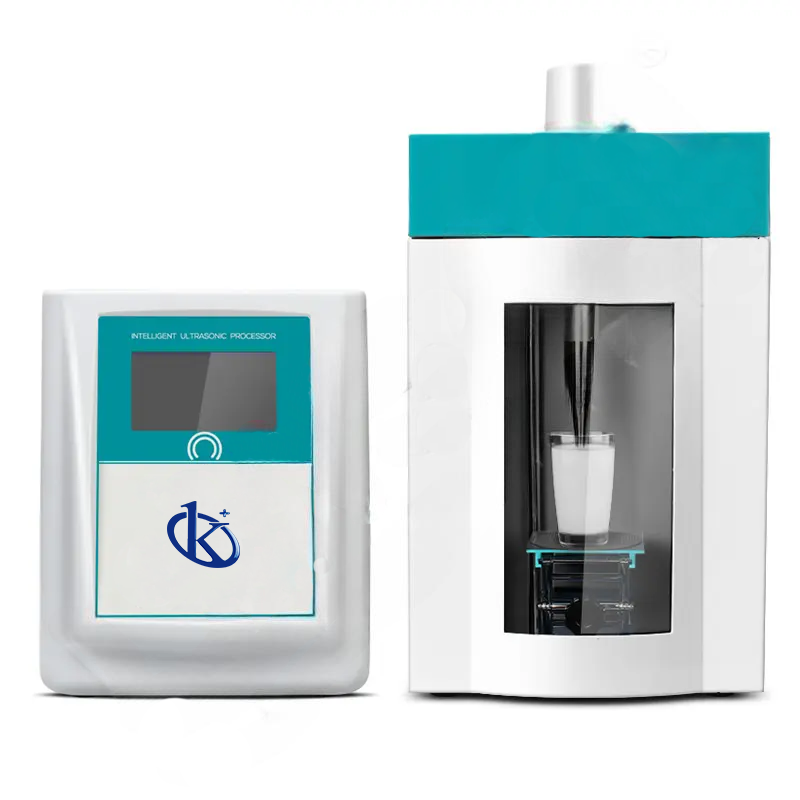
How Ultrasonic Homogenizers Facilitate University Research Projects
In the realm of academic research, the pursuit of precision and reproducibility is critical. Ultrasonic homogenizers serve as indispensable tools for researchers looking to achieve consistent sample preparation. This article delves into the various applications of ultrasonic homogenizers within university research and academic projects, highlighting their significance in achieving research goals.
Understanding Ultrasonic Homogenizers in Academic Research
Ultrasonic homogenizers utilize high-frequency sound waves to agitate and disperse samples, resulting in a uniform mixture. This technology is particularly valuable in university laboratories where varied sample types are analyzed. By achieving consistent particle size reduction and dispersion, researchers can enhance the accuracy of their experimental outcomes, which is crucial for thesis-level reproducibility.
Applications of Ultrasonic Homogenizers in Research
Different ultrasonic homogenizer models offer unique features that cater to specific research needs. For example, the Ultrasonic homogenizer YR05015 is suitable for small sample volumes of 0.1 to 150 ml, making it ideal for preliminary research stages. Conversely, the Ultrasonic homogenizer YR05020 can accommodate larger samples up to 1,200 ml, supporting extensive experimental setups.
Comparison of Available Models
| Model | Power (W) | Mixing Capacity (ml) | Frequency Range (kHz) | Best For |
|---|---|---|---|---|
| YR05015 | 1.5 – 150 | 0.1 – 150 | 20 – 25 | Small samples and preliminary tests |
| YR05016 | 2-5 – 250 | 0.1 – 300 | 20 – 25 | Medium sample sizes |
| YR05017 | 10 – 650 | 0.1 – 500 | 20 – 25 | Versatile applications |
| YR05018 | 10 – 900 | 0.1 – 600 | 20 – 25 | High-throughput research |
| YR05019 | 20 – 1,200 | 1 – 1,000 | 20 – 25 | Large-scale projects |
| YR05020 | 50 – 1,800 | 1 – 1,200 | 20 – 25 | Extensive academic research |
Common Mistakes and How to Avoid Them
One of the common mistakes researchers make is underestimating the power requirements of their ultrasonic homogenizer. Each model has a specified power range, and selecting a model with insufficient power can lead to inadequate sample processing. For instance, the YR05019 offers up to 1,200W, making it suitable for demanding applications.
ROI and Cost-Effectiveness of Ultrasonic Homogenizers
Investing in an ultrasonic homogenizer can lead to significant cost savings in the long term. When evaluating ROI, consider factors such as reduced reagent waste and improved reproducibility leading to fewer experimental failures. A model like the YR05018 can enhance throughput, justifying its higher initial cost by increasing overall research efficiency.
Safety Considerations in Using Ultrasonic Homogenizers
University laboratories must prioritize safety when employing ultrasonic homogenizers. Ensuring that researchers use appropriate PPE and follow safety protocols can mitigate risks associated with aerosol generation during homogenization. Models like the YR05020 come with built-in safety features that help minimize potential hazards.
Frequently Asked Questions
What are the key features of ultrasonic homogenizers for university research?
Ultrasonic homogenizers such as the YR05015 and YR05020 feature variable power settings and mixing capacities, making them adaptable for different research needs. Their ability to provide precise temperature control and automatic alarms for operational errors enhances their usability in academic settings.
How can ultrasonic homogenizers improve sample preparation in academic projects?
Devices like the YR05016 can improve sample uniformity and reproducibility, critical for academic projects. By consistently reducing particle size, they ensure that experimental results are reliable and can be replicated, which is essential in the research community.
Which ultrasonic homogenizer is best suited for high-throughput applications in research?
The YR05020 is ideal for high-throughput applications due to its high power capacity of up to 1,800W and mixing volume of 1,200 ml. Its efficiency in handling larger samples makes it perfect for extensive research projects.
How does ultrasonic homogenization contribute to sustainability in research?
Ultrasonic homogenizers, such as the YR05018, can reduce the overall consumption of reagents by enhancing mixture efficiency. This leads to lower waste generation, contributing to more sustainable laboratory practices essential for modern academic research.
What factors should be considered when choosing an ultrasonic homogenizer for research labs?
Factors like sample volume, power requirements, and safety features should be considered. Models such as the YR05017 provide versatility for varying research needs, making them a prudent choice for many laboratories.
How do ultrasonic homogenizers maintain temperature control during use?
Ultrasonic homogenizers like the YR05019 have built-in temperature control mechanisms to prevent overheating during operation. This is crucial for maintaining sample integrity and achieving accurate research results.
What is the best ultrasonic homogenizer for smaller research projects?
The YR05015 is ideally suited for smaller projects due to its compact size and capability to handle sample volumes from 0.1 to 150 ml. This model allows researchers to conduct experiments efficiently without the need for larger equipment.
If you are looking for a fusion of innovation and quality, you have come to the right place. At Kalstein, we offer you the luxury of exploring our exclusive catalog of laboratory equipment. We manufacture every device to the highest standards of excellence. Our intuitive and seamless online purchasing channels are designed for your convenience, securing the most competitive prices. Hesitate no longer — we bring science to life, it is time to become part of our community.