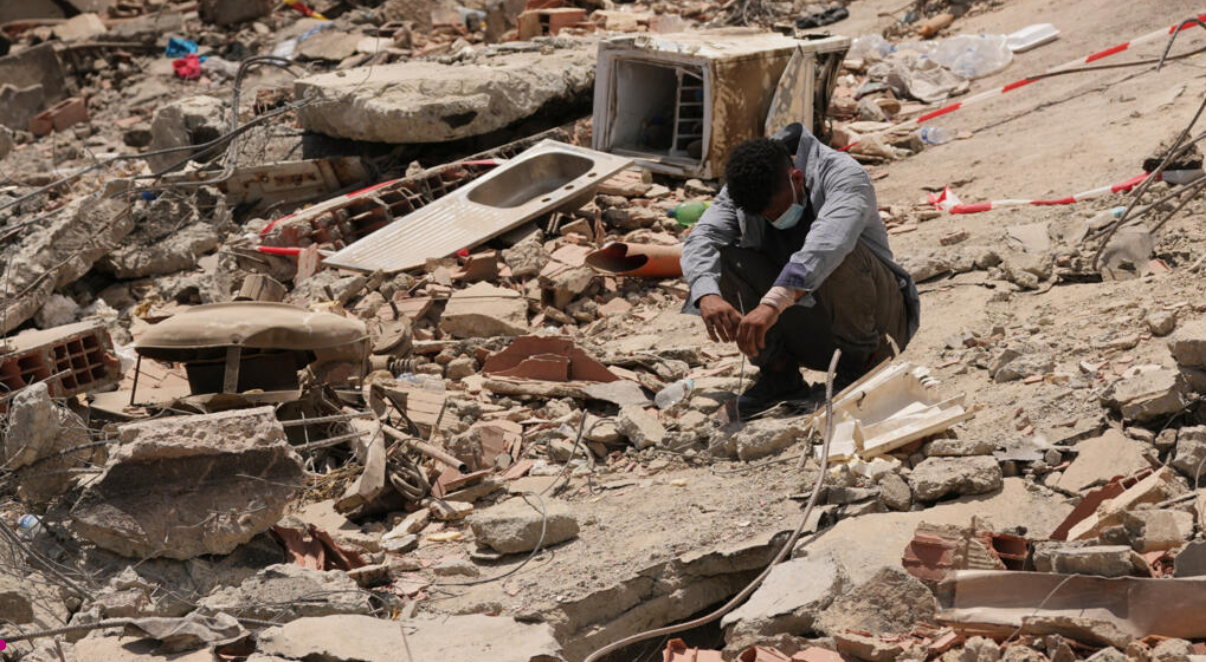
Six Days After the Earthquake, Hospitals Resort to Emergency Measures
Six days after the June 24 earthquake, hospitals in La Guaira and Caracas are requesting quicklime to preserve the bodies of victims due to a lack of sufficient cold storage facilities.
At the port of La Guaira, beneath the concrete silos that dominate the city, hundreds of bodies are piled up in improvised morgues set up in the open air. With temperatures exceeding 30°C (86°F), the odor has become, according to several witnesses at the scene, difficult to bear. Six days after the June 24 earthquake, which has claimed at least 1,719 lives and left around 50,000 people missing, according to UN estimates, the issue is no longer only about finding survivors, but about how to preserve bodies that continue to deteriorate with every passing hour due to the heat.
Hospitals Request Formaldehyde and Quicklime
It is in this context that several hospitals have begun requesting formaldehyde and quicklime to slow decomposition. The request is driven by urgency: the country lacks body bags, refrigerated containers, and cold storage facilities capable of accommodating such a massive influx of bodies. According to the United Nations, which plans to deliver 10,000 body bags based on an estimate of 2,500 affected buildings, nearly all of these structures have completely collapsed.
A Method That Worsens the Problem It Is Meant to Solve
The use of quicklime for preserving bodies is normally prohibited, and for one specific reason: rather than slowing decomposition, it actually accelerates it. The process damages soft tissues, causes facial features to disappear, and erases fingerprints—the two main visual and biometric markers used to identify a victim when identification documents are unavailable. A social worker from a working-class neighborhood in Caracas, quoted by RFI, summarized the situation: quicklime "makes facial features and fingerprints disappear," but in a country that lacks sufficient plastic body bags and facilities to store bodies at low temperatures, "something has to be done immediately."
For families, this lack of appropriate equipment does not simply result in longer waiting times for news; it directly reduces the chances of identifying a loved one. As one woman searching for the body of her cousin in La Guaira explained, many victims were caught in their homes at the moment of the earthquake and were not carrying identification documents. Without fingerprints or recognizable facial features, scientific identification becomes almost impossible.
Toward Mass Graves Due to the Lack of Identification
A direct consequence of this shortage of equipment is that an undetermined number of bodies, degraded before any thorough forensic examination can be carried out, are likely to end up in mass graves without ever being identified. A doctor on site, speaking anonymously, described bodies recovered after several days beneath the rubble as already being in what he called an "extreme" condition—a state that the use of quicklime, rather than alleviating, only makes worse.
A Critical Shortage of Cold Storage Capacity
Beyond the international aid deployed on the ground—including rescue workers, search dogs, and body bags—it is this specific link in the response chain, the ability to preserve bodies at low temperatures long enough for proper identification, that is currently lacking in Venezuela.
Image credit: Matias Delacroix / AP